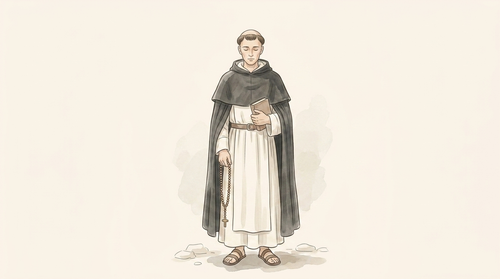
On the eleventh of July, the Church keeps the memorial of St. Benedict of Nursia, the quiet Italian monk who, without ever setting out to, taught the whole of the Western world how to pray.
He was born around the year 480, into a Roman world that was coming apart. As a young man he went to study in Rome and was so troubled by what he found there that he left it all behind for a cave at Subiaco, where he lived alone for three years, seeking God. Others were drawn to him. In time he founded the great monastery of Monte Cassino, and there he wrote the Rule that still bears his name, a small book of astonishing balance and gentleness that would shape monasteries, and Europe itself, for fifteen centuries. His sister, St. Scholastica, whom tradition lovingly remembers as his twin, walked the same road. Pope St. Paul VI named him a patron of all Europe in 1964.
A day made of prayer
That in all things God may be glorified.Rule of St. Benedict, ch. 57 · cf. 1 Peter 4:11
The genius of Benedict can be gathered into two Latin words that have hung over Benedictine life ever since: ora et labora, pray and work. He did not carve the day into holy hours and ordinary ones. He wove prayer straight through the labor of the kitchen, the garden, the guest house, and the field, so that the whole of a life, and not only its still moments, might become a prayer. That in all things God may be glorified: he wrote it, and he meant all things.
That is his gift to those of us who will never live inside a monastery. Prayer is not something we must wait for silence to begin. It can be carried into the morning commute, the sink full of dishes, the waiting room, the long afternoon. This is, quietly, the whole spirit of the Rosary: a prayer that asks only your hands and your attention, and fits the shape of an ordinary day. Many a soul has discovered, as Benedict did, that God was waiting in the middle of the work all along.
A prayer you can hold
Benedict is remembered, too, for something small and much loved: his medal. For centuries the faithful have carried the Cross of St. Benedict, and you will often find it set into the crucifix of a rosary. Around its edge runs an old prayer, worn down to single letters, that reads in part: May the holy Cross be my light; let not the dragon be my guide. Benedict is invoked against evil and temptation, a guardian in the spiritual fight, which is why his medal so naturally keeps company with the beads. To pray such a rosary is to hold his protection in your hand.
Keeping the day
You need not do anything grand to honor him when his day comes round. Offer an hour of your ordinary work as a prayer. Pray a single decade slowly, asking that God be glorified in whatever the day holds. Or simply pause and ask his help:
St. Benedict, who sought God above all things and found him in the work of ordinary days, teach us to pray as we live and to live as we pray. Guard us from all evil, and lead us, step by step, home. Amen.
Ora et labora. Pray and work. It is a rule small enough to carry, and large enough to hold a whole life. And if you find yourself wanting beads to carry into the work of your own days, our handmade rosaries are made for exactly that.
Frequently Asked Questions
Who was St. Benedict of Nursia?
A monk born around 480 in Nursia, Italy, who founded the monastery of Monte Cassino and wrote the Rule of St. Benedict. He died around 547 and is honored as the father of Western monasticism and a patron of Europe.
When is the feast of St. Benedict?
July 11 on the Church's General Roman Calendar, kept as a memorial. Benedictine communities also keep March 21, the traditional date of his death.
What does “ora et labora” mean?
“Pray and work.” It is the traditional summary of Benedictine life: a day in which prayer and ordinary labor are woven together, so that the whole of life gives glory to God.
What is the St. Benedict medal?
A medal bearing the Cross of St. Benedict and the initials of old prayers of protection, including “May the holy Cross be my light; let not the dragon be my guide.” It is often set into the crucifix of a rosary, and St. Benedict is invoked against evil and temptation.