On the thirty-first of July, the Church keeps the memorial of St. Ignatius of Loyola, and his story turns on a single instant. On a spring day in 1521, a French cannonball came over the wall at Pamplona and shattered the leg of a vain Basque soldier who dreamed of glory. It was the worst day of his life, and the best thing that ever happened to him, and it is not too much to say that the shot changed how the world prays.
For what doth it profit a man, if he gain the whole world, and suffer the loss of his own soul?Matthew 16:26, Douay-Rheims
The cannonball
Íñigo of Loyola was not a promising candidate for sainthood. The youngest of a large noble family, he was a courtier and soldier in love with fine clothes, romances of chivalry, and his own reflection. He was vain enough that when his shattered leg was badly set, he had it broken and set again, and ordered a protruding piece of bone sawn off, so that his boot would sit well. He tells us so himself, in the autobiography he dictated near the end of his life.
The long convalescence at Loyola was where God ambushed him. Íñigo asked for the tales of knights and ladies he loved. The house had none. It had exactly two books: a life of Christ and a collection of lives of the saints. He read them because there was nothing else, and then he noticed something that would become his life's great discovery. When he daydreamed of worldly glory, the pleasure faded and left him dry. When he imagined following Christ as the saints had, doing what St. Francis did, what St. Dominic did, the peace remained, and grew. Two kinds of thoughts, two aftertastes. He had stumbled onto what he would later call the discernment of spirits, and it began not in a chapel but in a sickbed, in a bored man paying attention to his own heart.
The pilgrim
When he could walk, he went. At the mountain shrine of Montserrat he kept an all-night vigil before the image of Our Lady, and when morning came he hung up his sword at her altar and walked away from the soldier he had been. He spent nearly a year at Manresa, living in poverty, praying in a cave above the river, and there he began writing the little book that became the Spiritual Exercises. He called himself, from then on, simply the pilgrim.
What followed was two decades of holy stubbornness. He went back to school in his thirties, a limping veteran learning Latin grammar among boys. At the University of Paris he gathered companions, among them St. Francis Xavier and St. Peter Faber, and in 1534 they bound themselves by vows in a small chapel on Montmartre. In 1540 Pope Paul III approved their company as the Society of Jesus, and Ignatius spent his last sixteen years in Rome as its first superior, governing a worldwide mission mostly by letters, thousands of them, signed under the motto that ruled everything: Ad maiorem Dei gloriam, for the greater glory of God. Readers of this Journal may hear an echo of St. Benedict's that in all things God may be glorified; the two mottoes are a thousand years apart and say the same thing. He died at his work in Rome on the thirty-first of July, 1556, and was canonized in 1622.
Praying with the imagination
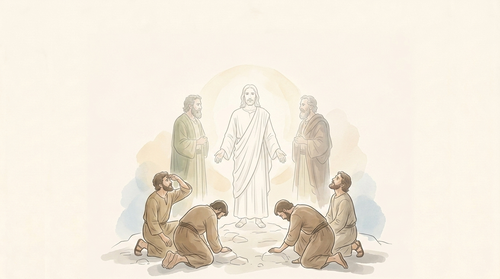
The heart of the Exercises is a way of praying that Ignatius learned in that sickbed: do not merely think about the Gospel, enter it. He called it composition of place. Stand in the scene. See the road to Bethlehem, hear the crowd at the pillar, feel the weight of the Cross on the shoulder, watch the stone roll back. Prayer, he insisted, is not only for the intellect; God gave us an imagination, and it too can kneel.
If that sounds familiar, it should. It is exactly what the Rosary has always asked of us. Every decade names a mystery, a scene, and invites us to live inside it for the space of ten Hail Marys. The beads are a pilgrim's method of composition of place, older than Ignatius and fitting in a pocket. He gave the Church a map for the kind of prayer the Rosary had already taught her to walk. If you have ever prayed a decade slowly and found yourself standing in the garden or at the tomb, you have prayed as Ignatius prayed.
Keeping his day
Two small ways to keep his memorial, both borrowed straight from him. Tonight, make his sickbed discovery your own: look back over the day for a few quiet minutes and notice what left you dry and what left you in peace, and thank God for the second. And pray one decade the Ignatian way: choose a mystery, build the scene with your senses, and stay in it, unhurried. Then make his own prayer yours:
Take, O Lord, and receive all my liberty, my memory, my understanding, and my entire will, all that I have and possess. Thou hast given all to me; to Thee, O Lord, I return it. All is Thine; dispose of it wholly according to Thy will. Give me Thy love and Thy grace, for this is sufficient for me. Amen.The Suscipe of St. Ignatius
Ignatius hung his sword at Our Lady's altar and walked away with nothing but a pilgrim's resolve. If you would like beads to carry on your own pilgrimage, our handmade rosaries are made for exactly that.
Frequently Asked Questions
Who was St. Ignatius of Loyola?
A Basque soldier, born in 1491, whose conversion began while recovering from a cannonball wound at Pamplona in 1521. He wrote the Spiritual Exercises, founded the Society of Jesus (the Jesuits), approved in 1540, and died in Rome on July 31, 1556. He was canonized in 1622.
When is the feast of St. Ignatius of Loyola?
July 31, the day of his death, kept as a memorial on the Church's General Roman Calendar.
What are the Spiritual Exercises?
A structured school of prayer and discernment written by St. Ignatius, built around meditating on the life of Christ, often by imaginatively entering the Gospel scenes, and learning to notice the movements of consolation and desolation in the soul. They remain the basis of Ignatian retreats today.
What does AMDG mean?
Ad maiorem Dei gloriam, Latin for “for the greater glory of God,” the motto of St. Ignatius and of the Society of Jesus.