On the twenty-fifth of July, the Church keeps the feast of St. James the Greater, the fisherman who left his nets, stood closer to Jesus than nearly anyone alive, asked for the wrong throne, and became the first of the apostles to die for the Lord he had followed. Fifteen centuries of pilgrims have walked across Spain to pray at his tomb, and they are walking still.
Can you drink the chalice that I shall drink? They say to him: We can.Matthew 20:22, Douay-Rheims
The fisherman in the inner circle
James was a son of Zebedee, a Galilean fisherman, and the brother of St. John. The Gospels show us the moment everything changed: Jesus, walking by the sea, saw the two brothers in the boat with their father, mending their nets, and called them. They left the nets, and the boat, and their father, and followed Him.
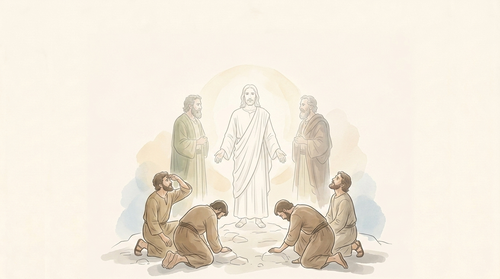
What followed was an intimacy given to almost no one else. With Peter and John, James belonged to the inner three, present where the other apostles were not: in the room where Jesus raised the daughter of Jairus, on the mountain when He was transfigured in glory, and in the garden of Gethsemane on the night of His agony. Anyone who prays the Rosary has stood in two of those scenes, the Transfiguration among the Luminous Mysteries and the Agony in the Garden at the head of the Sorrowful. James was bodily there for both, and he slept through the second, which ought to console every distracted soul who has ever nodded off mid-decade.
Sons of thunder
He was not a gentle character. Jesus nicknamed James and John Boanerges, sons of thunder, and the Gospels show us why: when a Samaritan village refused to welcome the Lord, the brothers offered to call down fire from heaven on it. On another day their mother came asking that her sons sit at His right and His left in the kingdom. The answer Jesus gave was the question above: can you drink my chalice? They said we can, almost certainly without understanding what they were promising. He assured them that they would.
For James the chalice came first and came quickly. Around the year 44, King Herod Agrippa had him put to the sword in Jerusalem. The Acts of the Apostles records it in a single verse, and it makes him the only apostle whose martyrdom is written in the New Testament itself. The man who wanted a throne got a chalice, and drank it first of all the Twelve.
The road to Compostela
An ancient tradition holds that James preached the Gospel in Spain before his death, and that his relics were carried there afterward, coming to rest at the place now called Santiago de Compostela. Around that tomb grew one of the great pilgrimages of the Christian world, the Camino de Santiago, the Way of St. James, walked for over a thousand years by the faithful wearing his emblem, the scallop shell. Whatever historians make of the tradition's details, the road itself is simple fact: millions of ordinary people, century after century, setting out on foot to pray. Spain keeps him as her patron, and pilgrims everywhere keep him as theirs.
There is something fitting in it. The man who once wanted the best seat became the saint of people willing to walk a very long way on sore feet, asking for nothing but grace at the end of the road.
Keeping his feast
You need not walk to Spain to honor him. Make a small camino of your own: take a walk you would have taken anyway, and pray a decade of the Rosary as you go, one bead per step if you like, offering it for pilgrims, for travelers, and for anyone still far from home. Or simply pause and ask his help:
St. James, son of thunder and friend of the Lord, who asked for glory and received a martyr's chalice, teach us to follow without bargaining, to walk without wearying, and to want what Christ wants to give. Amen.
Pilgrims on the Camino carry little: a shell, a stick, and very often a rosary. If you are looking for beads to carry on your own road, our handmade rosaries are made for exactly that.
Frequently Asked Questions
Who was St. James the Greater?
A Galilean fisherman, son of Zebedee and brother of St. John the Apostle. He belonged to Jesus' inner circle of three, witnessed the Transfiguration and the Agony in the Garden, and around the year 44 became the first apostle to be martyred, put to the sword by Herod Agrippa in Jerusalem (Acts 12:1–2).
Why is he called “the Greater”?
To distinguish him from the other apostle named James, the son of Alphaeus, called “the Less.” The titles traditionally reflect that the son of Zebedee was called by Jesus first, not a ranking of holiness.
When is the feast of St. James?
July 25, kept as a feast on the Church's General Roman Calendar. He is the patron saint of Spain and of pilgrims.
What is the Camino de Santiago?
The Way of St. James, the ancient pilgrimage across Spain to Santiago de Compostela, where tradition holds the apostle's relics rest. Walked for over a thousand years, it remains one of the great pilgrimages of the Christian world, marked by the scallop shell, St. James' emblem.